Showing posts with label malazan. Show all posts

Friday, 17 October 2014

Review: Of Bone and Thunder


 Of Bone and Thunder by Chris Evans

From my brief investigations into the author (Chris Evans of The Iron Elves trilogy) it would seem that he’s a bit of a military historian and I definitely think that’s where this book stems from. It’s a story inspired by the Vietnam War (obviously with a fantasy twist) and you definitely get the impression straight away of confusing objectives coupled with oppressive heat. 


Of Bone and Thunder starts off in a slightly confusing manner, what with the prologue being from the perspective of a bird, but it very quickly drags you in and becomes a visceral, pumping tale that feels very real.

We start following normal soldiers doing a normal day’s work in heat that should only be experienced when you’re standing next to an industrial oven. We move on to a less normal soldier but still doing what amounts to a roughly normal day’s work. And finally we find ourselves following an airborne regiment doing a kind of normal day’s work.

We do see that the Kingdom back home is in turmoil and has almost exploded into open rebellion whilst conscripted soldiers fight in a searing hot jungle for a cause they don't know about.

I felt like, to start with, the plot meanders slightly with regards to the soldiers on the ground, rather than being propelled onwards into the maw of some great big bad evil end of the world nonsense. But I think that is also kind of the point with soldiers fighting a war that they see as pointless. That isn’t to say that the story isn’t compelling; we find ourselves sucked into the very real struggles of the soldiers on the ground (and air). 

One of my favourite parts of the story is the rags (read: dragons). Evans uses them to create dragon-based air squadrons. And it’s awesome. There’s something about the way Evans describes them that makes them feel heavy, hot, and oh so real and dangerous. And that’s before they even start breathing fire. I love it.

It’s compelling in its characters and every page reveals something deeper in each of the characters that makes you more interested in them. You become invested in the characters as you see their faults, their love for their comrades, and what they are willing to do to keep one another safe.

Evans does a great job of not pulling any punches or trying to glamorise warfare but at the same time the crescendo to the story will still get you cheering for the characters at their triumphs (I was smiling like a goon on the train). 

I thoroughly enjoyed this book and thought it was a detailed exploration into the minds of soldiers on the ground, how social change affected them, and the stresses of dealing with a command structure unprepared for the environment they faced. 

It was well written, the characters were quite flawed but ultimately sympathetic and I found myself excited to get back to it. What more could you ask for?! Dragon? It has that too!

I would definitely recommend this book to fans of the Malazan series. This book is a dark exploration of war that still has also those features that make you want to read on and dig deeper into the world, the characters, and the conflicts.
Continue Reading...

Monday, 28 July 2014

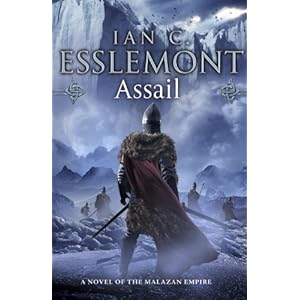
Book Review: Assail by Ian C Esslemont

Look at it! It's so awesome!


Hopefully I was not alone in my giddy excitement when I saw the title of this book.

Assail.

All Malazan fans will know the weight that sits on that continent. Throughout Erikson’s series we have seen some of the toughest characters be chewed up and spat out by Assail. And sometimes they even survive.

We enter the world of Malazan once again as we always do, with some new characters and some old faces, and I think by now with 15 books under most readers’ belts (I’m going to assume that you’ve read Esslemont’s series after you read Erikson’s) we have enough context that we are immediately drawn into the new stories. A young man from one of the tribes on Assail and a sea-captain on his way to the fabled continent are a couple.

Esslemont does a wonderful job of building tension and suspense in the first portion of the book. We are only given fleeting glimpses into what lies at the heart of the continent and what terrible things might happen. Further to this we are thrown a complete curve-ball with the prologue and only left with burning questions.

Esslemont builds on this consistently throughout the entire book and we are given hints, both great and small, about what is happening and important revelations about the world. I could barely put the book down in the first half for all of these hints and questions (I almost missed my stop a couple of times on the train) and then by the time the second half of the book comes around you’re caught up with the momentous plot you can’t put it down then either!

I will say that for some reason around Chapter Six there was this weird explosion of adverbs. As though Esslemont realised that adverbs can be okay sometimes and got a little carried away. It was a little off-putting once I realised he wasn’t doing it deliberately with one character to try and make a statement about their POV, but then after that chapter it dies down and all is well with the world.

Apart from the ‘Adverb Attack of Ch. 6’ Esslemont’s language is diverse and descriptive, and I did note at times how wonderfully creepy he could be (in all the right places). Esslemont’s voice really shines and I think that he has developed wonderfully since ‘The Night of Knives’ way back in 2004. He gives the proper weight and sadness to those characters and scenes that need it but is also a dab hand at cracking jokes. There was a wonderful moment in a climactic fight scene towards the end that did give me a mighty chuckle.

The Epilogue does a wonderful job of tying everything together in a neat little bow. I did wonder whether it was necessary and should have been a final chapter, but perhaps that’s just pedantic of me? Regardless, the Epilogue ties all of the threads of this book together and then shows us some of the paths the characters want to take next. So instead of leaving us with the unanswered questions that we were sometimes left with in Erikson’s work, Esslemont ties everything together and then scatters the seeds for the next round of storytelling. And each and every single one of those seeds should be an epic story in its own right.

By the time we reach the end of the book the world has been suitably threatened, our view on it has been suitably rocked, and we have had our hearts suitably broken. All in all, Esslemont continues to build and improve on his previous work. Every volume increases in complexity, skill, and epic scale.

I absolutely urge any fantasy fan to read the Malazan series, and if any Malazan fans are hesitant to pick up Esslemont’s series after what a good job Erikson did, I can assure you that you will not be disappointed. Esslemont has at least 3 more books to go and I for one cannot wait to read them. 


Assail is released on the 14th August and you can preorder it in hardback or ebook from Amazon, or from the publisher's website.
Continue Reading...

Wednesday, 9 July 2014

Review: Orb Sceptre Throne - Novel of the Malazan Empire

 
Well I think you can understand now why the gap in blog posts, eh? It was because I was reading through a Malazan book.

So, fair warning, if you haven't read any of Steven Erikson's Malazan Book of the Fallen series or Ian C. Esslemont's books which don the subtitle 'A Novel of the Malazan Empire' on each cover then I suspect this is all going to sound like gibberish to you.

This time I'm working my way through the Ian C Esslemont series Novels of the Malazan Empire which is obviously set in the same world and deals with largely new ground. And this review might seem a bit sparse on the details but then again, if I reveal too much I actually have the potential to ruin two whole separate epic fantasy series... so we'll see how it goes.

And which book, I hear you ask? (that was creepy, how did you do that?) Well, Orb Sceptre Throne, book number four in Esslemont's series. And if you don't like Amazon links, well then here's a link to the publisher's website.

Some of the characters we know and love appear in this book, set as it is in Darijhustan, so we see Kruppe, Rallick Nom makes an appearance among others. In terms of the timeline for this book it's sits neatly after Erikson's Toll the Hounds but also before the finale of his series.

One of the things I am supremely enjoying about Esslemont's works of the Malazan world is that he is exploring all the things that Erikson never had the time to (I rather suspect this was divided neatly by the two of them before either started writing). In this book alone we learn more about the Seguleh, the Moranth and the interesting history of Darijhustan. Now if that's not enough on its own to make you read this then I don't know what will be! But I'll keep going nonetheless.

Of all of Esslemont's books that I have read so far, this one has felt far and away the best of them. I'm not sure if it was the plot, the pacing, the characters or the writing alone that made it feel like that but I suspect it was rather the collection of all of them.

Rather than starting the book in the typical Malazan fashion which is to say plopped down and left to figure out who's who, rather like a party-goer who decided to use the skylight instead of the door, we already know most of the players here. Or at least if not the players then where the players come from which gives us much needed context.

Granted, a lot of that context comes from Erikson's books, but it still felt nice to dive straight into this and look at the echoes of events from Toll the Hounds and before. So I think you would definitely need to have read up to there with Erikson's books before you have a go at this one, some of the characters are the same and you definitely do not want to spoil the events of Toll the Hounds! So I would say, as a standalone work, that is probably this book's only downfall (if it can be called that!)

Enough time has passed and the scenery has so changed that there is an aura of mystery about the place and we're not sure why that scholar is digging around in the wells outside the city, or what he found down there, but I know darn well that it's not going to end well.

Esslemont weaves together all the strands of the story and pushes all the characters together from far flung islands to the glowing blue city in a wonderful manner.Towards the end of the novel the pacing is swift as all of the storylines begin to come to a head and you will find it hard to put down. When you reach the final 100 pages or so, it just becomes really hard to stop reading, one thing comes after another like an avalanche.

Overall I very much enjoyed this novel. There were times when I did pause to appreciate a well crafted metaphor or simile and other times when I was swearing under my breath purely to get the excitement of the events out of my system somehow (hopefully my commuter companions didn't mind). There was always something going on, never a dull moment, and Esslemont definitely met the high bar of scale, colour, and soul-shattering twists and revelations that Erikson has set.

If you weren't as enamored with any previous Esslemont books and were worried where he would take the series, I say to you; Worry no more! He has created a wonderful epic with this novel and once you have devoured this (disclaimer: please don't eat your books it will not make you gain the power contained within their yummy pages) you won't be able to wait for the next volume! And, what luck, you don't have to!

But in all seriousness, I thoroughly enjoyed this book. And if you are a Malazan fan who has reached Toll the Hounds, or finished the Book of the Fallen, then I urge you to read up to this volume, it will sate your undying curiosity for the Malazan world, but still leave you wanting more.


I am sorry I couldn't say any more about the meat and bones of the book, but in defence of my reticence I've already been told off by my friends for giving spoilers...
Continue Reading...

Wednesday, 26 June 2013

When I Finished Malazan (Or the Day I Cried on the Train)


Okay, I’m going to start this week’s article off with a couple of points just for some context. First off,  I get most of my reading done on the train to and from work, because it’s nice to just have an hour either way that I can just spend reading without worrying about chores, blogging or anything else.

And secondly, I’m a pretty big fan of epic fantasy. I love a sprawling adventure with Homeric style gods and heroes and a storyline to rival mythology. It’s even why I did two degrees in Classics and Ancient History. So it’s understandable that when I started reading Malazan: Book of the Fallen by Steven Erikson I quickly fell in love with it.

Spanning an 10 books with an average of 1,146 pages and 330,003 words per book, the story covers multiple continents and hundreds of thousands of years. Well the books don’t cover hundreds of thousands of years, but they do tell you about the history and ... well I won’t go on too much about that, but it’s safe to say that it’s pretty darn epic.

And last week, I finally finished it.

So I thought it was about time that I reviewed Malazan, and instead of just reviewing one of the books I am going to review (to the best of my abilities) the series as a whole. I will be looking at the writing, the story, the pacing and the characters but just taking into account the whole series instead of the individual instalments. And having already said how much of a fan I am of epic fantasy I think it is important to try and do this review as evenly as possible so I won’t just be talking about the positives. I’m going to try as hard as I can not to give any spoilers and I will read and reread this article to make sure!


So let’s get the negatives out of the way early!

The Malazan series definitely starts as an uphill struggle, one of my good friends has described it as ‘Fantasy for fantasy fans’  and I agree. Erikson is not a fan of holding the readers by the hands as they come to terms with the strange new world they find themselves in. You’re immediately thrown into a world with a rich history and diverse political backdrop with minimal guides to help you understand all of it. With this particular aspect of his storytelling it seems like Erikson really takes to heart the mantra of ‘show don’t tell’. Even with that being said, the story of the first book Gardens of the Moon, is relatively small within the scale of the Malazan series so Erikson at least lets you in at the shallow end. But he doesn’t tell you how to swim.

A point that runs alongside that is the tendency for storylines and prose that don’t seem relevant from the reader’s perspective. I can think of about three or four examples of this, although within the later books (I won’t specify them in case I give anything away). But one example I will give specifically is that in one of the later books he has sections of text written as though they are narrated by one of the characters, Kruppe to be exact. However, the problem I found with this is that Kruppe is never exact. He is a highly amusing character and has some wonderful speeches throughout the series, but with his complexity comes a need to use him sparingly. And so I did find myself mentally exhausted at some parts when Kruppe was giving his narrative. But I have also had conversations with people who fell in love with Kruppe and couldn’t get enough of him so this may be a case of personal opinion.

Additionally I found myself irked by the way Erikson started quite a few sections that moved to a different point of view. There would be a couple of paragraphs of description and setting before he named the character or gave enough description that the reader could then realise what character this particular section was narrating. Although, in fairness, this mostly annoyed me due to my own impatience and wanting to read about certain characters. 


But I don’t want the negatives to throw you away from the series, it takes a bit of time to get into but once you get there the payoff is immense. So let’s look at what I did like about the series.

Well, I’ve said I like epic fantasy, and it is truly epic. Without counting the magical realms that are used throughout the series, the story spans at least three continents. And in true fantasy style humans are only one of many different races and not all of them humanoid. There’s the undead cavemen that are the T’Lan Imass; the ancient reptilian race of the K’Chain Che’malle; and the giant secluded Toblakai. Steven Erikson follows characters from every single race so we really get the full scope of the world as we go through the series. That in itself shouldn’t necessarily be a reason to pick up a book, you could have a novel that’s very epic but poorly written and plotted. Erikson doesn’t write poorly, his plot is well planned and the pacing keeps you reading.

Moving on from the setting, the characters themselves are compelling and interesting, there is never a character placed just to fill a space. And each and every one of them has their own backstory, drives and motivations. Along the same lines Erikson doesn’t push the plot along merely to get his characters in a certain place or, indeed, push the characters to do something contrary just to get the plot to a certain place. In this way I found that the story was always intriguing and unpredictable, not just because Erikson wants to keep you guessing meaninglessly but because you can’t say what life will throw at the characters next.


I will admit that I have a slight bias, as I don’t mind making my way through books that are positively tomes that could be used as weapons. But whilst he definitely keeps you entertained throughout the book Erikson makes the journey to the end of each book absolutely worthwhile. The man can do endings. You know that feeling where you have to put down the book and just think ‘Flip. That was awesome/ridiculous/has so many implications.’ That’s pretty happens a couple of times at the end of every book. The number of times that the hairs lifted on my neck as I reached a climactic and impressive part of the story became too many to count.

This does feed in a little bit with the con that it takes a long time to get all the context in order for this series. Once you’ve got the context of the setting and the history that’s been created for the world of Malazan the payoff is huge. I wouldn’t blame anyone for not pushing through to get to those endings but I would also definitely say you should not give up on it. 

I have seen Erikson called a master of both tragedy and comedy and you will definitely see that throughout this series. Characters like Kruppe, Tehol and the Korbal and Bauchelain duo will have you laughing as you read. But as you reach some climaxes in the series (I won’t say which ones) you will find yourself shedding a tear or two for the characters and their pitfalls. And this was my mistake. As I read the climax to the series I found myself on the edge of my seat leaning into the book hoping to dive even deeper, there was a lot of wide-eyed stares at the pages and a couple of teary eyed glances out the window.

The story is presented to you with excellent writing, interesting plots (most of the books are self-contained but have an overarching story throughout the series that culminates in the later books) and three dimensional characters.

The series does take some time to get into, for example it takes him until the sixth book to actually give a definition of the magic system, despite the fact that by then you’ve figured it out by yourself. But that’s mainly because the world is so rich it would just be ridiculous to try and give you all of the information at once. The reason that the endings are so effective, spectacular and simply epic is because of all that context and the rich world. 

I have laughed with this series and I have cried with this series, Erikson took my on a truly epic journey and left me speechless. Reading this series has definitely affected me and I think changed my outlook. For all of its faults this series is phenomenal, I cannot recommend it enough. I genuinely felt lost for a good few days when I had finished the series, bereft at the sudden lack of those same characters in my life.

If the Malazan: Book of the Fallen is a series you’ve been umming and erring about I strongly recommend you pick it up. Yes, it’s long. Yes, it’s daunting. And yes, it’s well worth it. 

 
Continue Reading...

Friday, 21 June 2013

The Mathematics Of Magic

So how do you explain magic? Well that’s just it, isn’t it? It’s magic, it is the unexplainable, the fantastic and the absurd. But more and more magic is becoming a quantifiable thing within fiction as more heavily imposing ‘magic systems’ are written into fiction. Don’t get me wrong, I love a good magic system, but surely there’s also a point where you have to say “well, it’s magic.” So this article is going to be about the pros and cons of having a magic system.


One of the first pros for a magic system (and vice versa that this is a con for non-regulated magic) is that it stops the characters from using magic as a get out of jail free card. The reason that I say this is that without explaining how magic works to the reader, or at least showing the reader what magic can do and what it can’t do (after all, the rule is show don’t tell!), you can use it to do anything.


A nice simple example of this is where you pull the energy for magic from. If it’s not defined then it can leave the reader in suspense and make it a lot easier to surprise the reader, but that also runs the risk that the character can always stay one step ahead and away from danger.


Take for example a magic system that define (very loosely) where magic gets its energy from. In Steven Erikson’s Malazan series the magical realms called ‘warrens’ are the source of magic and a wizard can draw on them to perform magical feats. But the more you ‘open’ your warren and the longer you hold it open for the more strain it puts on the wizards. So this sets a limit on the wizard’s use of magic as to how much of a magical battering they can take. 


Similarly when we look at Brandon Sanderson’s Mistborn series magical abilities are gained by ‘burning’ certain metals. Different metals produce different effects and you’re still subject to the laws of physics. So you can’t just stand on one leg and use magic to push a house down. That house is heavy and isn’t going anywhere, you’re going in the opposite direction.


So by having a system in place whereby you can see the limits of the use of magic it means that you can’t (without having a gaping maw of a plot hole) just use magic willy-nilly to save the day. So for Malazan you can’t just keep your warren open for as long as you want to do whatever you need, you’ll get torn apart. And for Mistborn, if you run out of metal then you’re just a normal person.


Check out the artist here: http://www.threadless.com/threadless/magic-bacon/
I was seriously surprised this picture existed.
Of course there is some expectation that something will swoop down and save the day (whether you want to live up to that or not is up to you!) but this will stop you from releasing the tension with: “And with a magical WHOOSH the enemy were all turned into dandelions and our heroes were swept away on a magic carpet made of bacon to forever romp in fields of butterscotch and quaff ambrosian wine! Huzzah!” 

Okay so maybe that’s an extreme example, but you get the idea. A tangible limit to magical forces, or how magical practitioners can use those forces restricts how much they can use it as a ‘get out of jail free’ card. This doesn’t mean you can’t push those forces, and push your characters to help them get out of those situations,  but it does mean that you then have a measurable cost for that push.


Another pro along the same line as this one is that a defined magic system that is known to the reader, if used correctly, can be used to build tension in the story. For example, if you have a magic user who finds themselves behind enemy lines and vulnerable but there’s something that the readers know will negate their magic, the story becomes a lot more tense as the readers wonder how the magician will get out of their hairy situation.


However, there are cons that come with a defined magic system of course. It can be easy to get carried away in the costing of powers and place too many limitations on your magic system. Why is this such a bad thing you ask? Well, ultimately because it’s magic! Magic is supposed to need our suspension of disbelief and not have us taking a pencil and paper to try and figure out how it was done. I believe that that sense of mystery and the fantastical is part of what makes the fantasy genre so compelling. Part of that universe is something that you can’t be explained, it can be utilized and you might understand it, but it can’t be explained away and made mundane. 


I think that whether or not you want to have an in-depth system for using magic ultimately comes down to how deeply you want magic to be used by your main characters in your books. If your protagonist is a heavy magic user then it probably won’t do to have magic as a completely unexplained phenomenon in your world. That’s why the young protagonist slowly learning along with the reader is a popular model. It develops the character and explains how the universe works at the same time.


But then if you would prefer your magic users on the border, as secondary or tertiary characters then the magical forces do not need to be well defined. It could even contribute to the plot, as the protagonist desperately tries to understand these forces that are being thrown around in a manner generally detrimental to physical health. By having magic without borders, magic is left as a mystical force in the universe. Something barely understood but that is entwined with the forces of life, creation, death and destruction.


I hope that you enjoyed this blog post, and that all you wordsmiths out there are forging prose with great grace and ease!


If you have any questions don’t hesitate to send me an email at: thetemperedpen@gmail.com or take a look over at the facebook page and write a comment.


Good hunting!


Magic Bacon Image (C) Wandering Bert: Check it out here - http://www.threadless.com/threadless/magic-bacon/
Continue Reading...

Followers

Follow The Author