Showing posts with label characters. Show all posts

Wednesday, 9 July 2014

Review: Orb Sceptre Throne - Novel of the Malazan Empire

 
Well I think you can understand now why the gap in blog posts, eh? It was because I was reading through a Malazan book.

So, fair warning, if you haven't read any of Steven Erikson's Malazan Book of the Fallen series or Ian C. Esslemont's books which don the subtitle 'A Novel of the Malazan Empire' on each cover then I suspect this is all going to sound like gibberish to you.

This time I'm working my way through the Ian C Esslemont series Novels of the Malazan Empire which is obviously set in the same world and deals with largely new ground. And this review might seem a bit sparse on the details but then again, if I reveal too much I actually have the potential to ruin two whole separate epic fantasy series... so we'll see how it goes.

And which book, I hear you ask? (that was creepy, how did you do that?) Well, Orb Sceptre Throne, book number four in Esslemont's series. And if you don't like Amazon links, well then here's a link to the publisher's website.

Some of the characters we know and love appear in this book, set as it is in Darijhustan, so we see Kruppe, Rallick Nom makes an appearance among others. In terms of the timeline for this book it's sits neatly after Erikson's Toll the Hounds but also before the finale of his series.

One of the things I am supremely enjoying about Esslemont's works of the Malazan world is that he is exploring all the things that Erikson never had the time to (I rather suspect this was divided neatly by the two of them before either started writing). In this book alone we learn more about the Seguleh, the Moranth and the interesting history of Darijhustan. Now if that's not enough on its own to make you read this then I don't know what will be! But I'll keep going nonetheless.

Of all of Esslemont's books that I have read so far, this one has felt far and away the best of them. I'm not sure if it was the plot, the pacing, the characters or the writing alone that made it feel like that but I suspect it was rather the collection of all of them.

Rather than starting the book in the typical Malazan fashion which is to say plopped down and left to figure out who's who, rather like a party-goer who decided to use the skylight instead of the door, we already know most of the players here. Or at least if not the players then where the players come from which gives us much needed context.

Granted, a lot of that context comes from Erikson's books, but it still felt nice to dive straight into this and look at the echoes of events from Toll the Hounds and before. So I think you would definitely need to have read up to there with Erikson's books before you have a go at this one, some of the characters are the same and you definitely do not want to spoil the events of Toll the Hounds! So I would say, as a standalone work, that is probably this book's only downfall (if it can be called that!)

Enough time has passed and the scenery has so changed that there is an aura of mystery about the place and we're not sure why that scholar is digging around in the wells outside the city, or what he found down there, but I know darn well that it's not going to end well.

Esslemont weaves together all the strands of the story and pushes all the characters together from far flung islands to the glowing blue city in a wonderful manner.Towards the end of the novel the pacing is swift as all of the storylines begin to come to a head and you will find it hard to put down. When you reach the final 100 pages or so, it just becomes really hard to stop reading, one thing comes after another like an avalanche.

Overall I very much enjoyed this novel. There were times when I did pause to appreciate a well crafted metaphor or simile and other times when I was swearing under my breath purely to get the excitement of the events out of my system somehow (hopefully my commuter companions didn't mind). There was always something going on, never a dull moment, and Esslemont definitely met the high bar of scale, colour, and soul-shattering twists and revelations that Erikson has set.

If you weren't as enamored with any previous Esslemont books and were worried where he would take the series, I say to you; Worry no more! He has created a wonderful epic with this novel and once you have devoured this (disclaimer: please don't eat your books it will not make you gain the power contained within their yummy pages) you won't be able to wait for the next volume! And, what luck, you don't have to!

But in all seriousness, I thoroughly enjoyed this book. And if you are a Malazan fan who has reached Toll the Hounds, or finished the Book of the Fallen, then I urge you to read up to this volume, it will sate your undying curiosity for the Malazan world, but still leave you wanting more.


I am sorry I couldn't say any more about the meat and bones of the book, but in defence of my reticence I've already been told off by my friends for giving spoilers...
Continue Reading...

Tuesday, 20 August 2013

How To Make the Best Swears for Your Book

So I know that the blog has been quite review heavy recently, so I thought it was time to mix it up and write an article that wasn’t about a specific book. But what does that leave me with? Well, quite a lot. So I sat and thought about what to write, and I settled on something to help make your world more thorough and real. Now this may not apply to everyone, so I apologise in advance if this isn’t for you. But, hopefully we can all learn something along the way!


World building. Love it or hate it, it’s definitely an important step for most science fiction and fantasy writers. You need to make sure you know how your world fits together, how all the elements work and what its limitations are. Maybe you don’t like worldbuilding and you’re a writer that just dives in and discovers things along the way, and that’s cool too. (Some people may even be very envious of you!) But I think most people like to at least have some sort of plan before we go ploughing off into the relative unknown of our stories.


Now, there’s load of aspects on world building, and the scope of it can range between genres and stories. Of course on how much you is dependent on you as the author, but if you’re writing a fantasy novel set in your version of a paleolithic Japan then there won’t be much point in mapping out the whole solar system!


Anyway, that’s not the aspect of worldbuilding I want to talk about today. Although there will be a blog post on it in the future. Today I want to talk about mythology, folklore and how that might affect phrases and colloquialism.

I think that this aspect of worldbuilding is something that can really add an extra dimension to your world and really bring your work together. They say it’s the little things, and I think they’re right (I don’t know who they are though), it’s the small things like unique swears or phrases that can really make a difference. This also means that if you’re just using phrases from the real world but you’ve taken a lot of time to build the rest of your world it can be jarring for the reader and bring them out of the experience.


Let’s take an example of how a badly inserted phrase could do this, we’ll use ‘By Jove’. And we’ll be assuming for this example that the world the characters inhabit is a completely separate world to our own. It has different continents, different gods, and magic; a fairly standard, but separate, fantasy world.


Now maybe you have a gentlemanly character and you want to keep him regal in the eyes of your readers but he’s just been surprised for whatever reason. “By Jove” would be a good way to maintain the appearance of a gentleman, if the story took place in the normal world.


But because it’s a fully fledged fantasy universe in its own right, the phrase doesn’t make sense. The phrase ‘by Jove’ essentially means ‘by God’ but is derived from the Roman god Jupiter. So if we’ve got a world where none of these gods existed then what our gentlemanly character has done is just said a random nonsense word. Hardly conduct that will keep him gentlemanly in the eyes of his peers.


So that’s one example of how a simple phrase can be jarringly out of place if you’re creating your own world. Similarly if you had a science fiction universe and someone used that phrase, if you’re using the real world as a base, how far into the future are you? Would that phrase still be used? It’s barely been a few hundred years and it’s already practically disappeared from modern use, so will it still be here in a few hundred more?


Right so that’s an example of something to look out for, there might a phrase you think nothing of putting in but it has its basis in something that you just don’t have in your universe. That said, don’t go too crazy with this, I like to think that if you’re reading a sci-fi or fantasy novel you can think of it being translated into something we can understand so I wouldn’t worry overly much.


But let’s look at an example of something you can create and hopefully give greater depth to your world.

We’re going to take the paleolithic Japan that I mentioned earlier as a random example, going through some aspects of the world we can create phrases and oaths that reflect the world the characters grew up in.


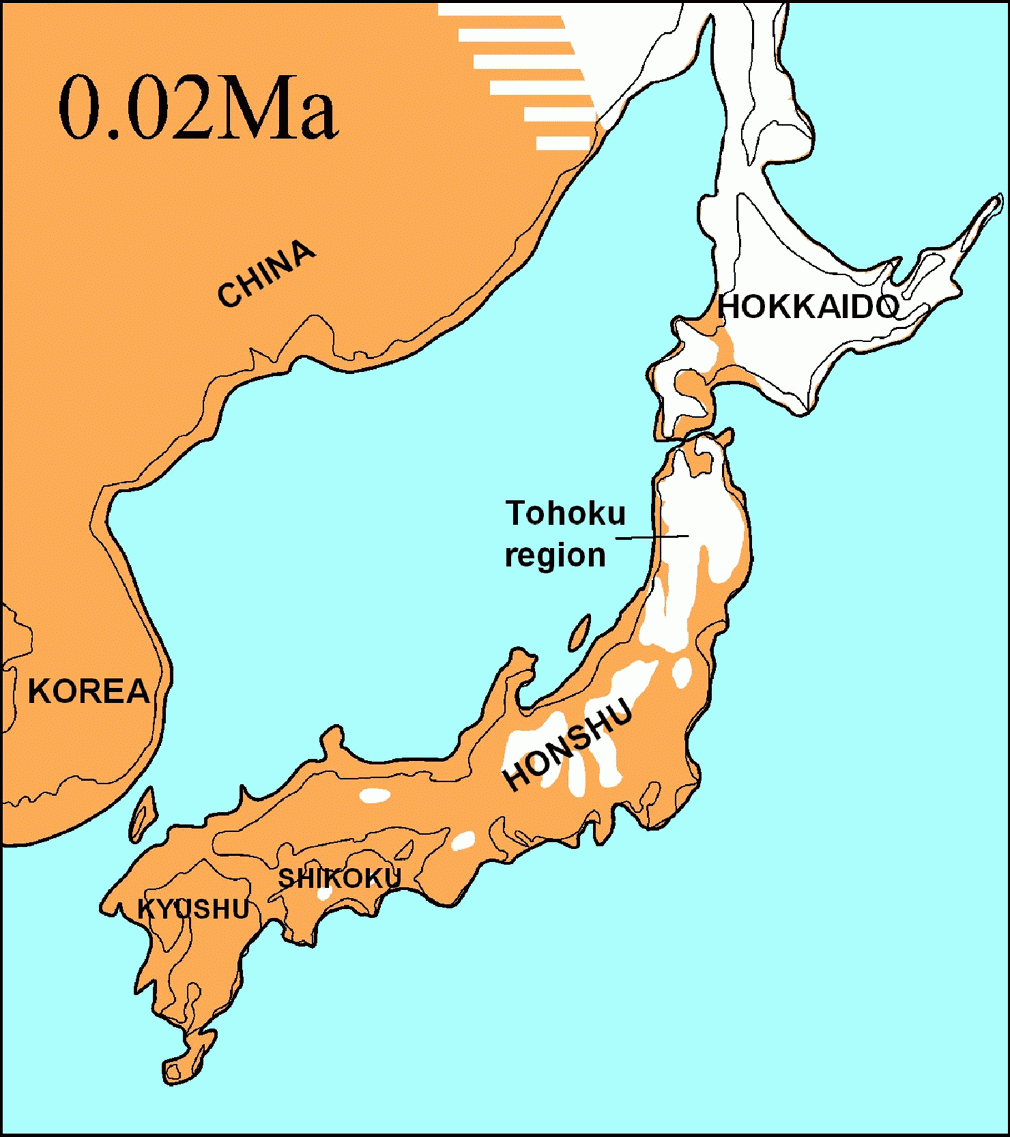
This story is going to be set at the end of the last ice age, so after a quick bit of research into the period and the area we know that Japan was connected to the mainland at this point and the general habitat would be forests and woodland for what is now Japan and tundra-like steppes for the bridge.


Paleolithic Japan, the black lines show the modern day countries


So, we have a few facts about the world our characters inhabit: There’s been a permafrost for longer than living memory; there’s deep forests in mainland; there’s wide open, almost barren, plains reaching far to the north, and they used mainly stone tools. By taking just these three facts about the world we can create a few phrases for our characters to use that will reflect the world they come from.


The permafrost can be used with regards to tenacity, stubbornness or for something that’s never going to happen, for example something like: “I’ll let you go when the ice melts!” in a similar vein to “when pigs fly.” You could use the ice and/or stone aspects for exclamations, perhaps: “Melted ice, boy! Get back here!” or “Broken stone that hurts!


These are just a couple of quick examples, but you can see how taking the aspects of the world that you have created and your characters inhabit can really add an extra dimension to your writing. It will really help to take the reader out of their world and firmly plant them into yours.


You could also use a similar technique to subtly suggest to readers that a particular character is from a different cultural background than those around him. If this strange character is using phrases and words that are strange to the people around him and alien to the setting then you can hint that the character is far travelled.


Anyway! I’m rambling now really. But hopefully from this you can see how these little touches can bring depth to your work and really hold the readers close.

I hope you’ve enjoyed this post and we shall of course be posting more in the very near future! In the meantime, good hunting!
Continue Reading...

Friday, 5 July 2013

5 Ways To Make You A Better Writer

The post today is all about different ways to improve your writing. Of course the best way is to write, write and then write some more! But here are a few ways to mix it up and try new and exciting methods at becoming the best writer you can be.

Writing VERY Short Stories

This challenge is based on the literary legend that Ernest Hemmingway was challenged to write a story using only six words. Hemmingway did so with the story:

“For sale: baby shoes, never worn.”

Point: Hemmingway. With only six words Hemmingway creates a powerful story but one that is made primarily by the reader with what they project onto the story. Hemmingway’s six word story is all about implication and reading between the lines (not that there’s much to read between).

So why not try writing your own six word story? Or ten or one hundred word story. As an exercise trying to write a story in a very small number of words will hone your ability to only put what is necessary into the prose. This way, you can avoid any writing that’s just fluff or perhaps writing that isn’t necessary to the storyline or character building.

So if you write a very short story every now and again it will help you become more concise in your writing, which will mean your readers are kept enthralled and pulled along by your prose. A win in any writers book (no pun intended)!

Describing Characters Without Naming Them

If we take a quick look at this video we can see how a three dimensional character can really make them stick out in your readers minds. (Side note: I’d recommend giving the full review a watch, he really takes apart the story and you can learn a lot of how NOT to do it, but a warning he does have some offensive language and the character he portrays might not be for everyone)

So you should ask yourself the same question of your own characters. Try and describe them to someone (either literally or just as an exercise, your choice!) without describing their features or what they do throughout the story. Just describe their personalities, and be sure to do this for your heroes and your villains.

How did you do? If you find yourself struggling then it might be worth taking some time to think about who your characters really are and what drives them. This is to make sure that you’re not just using characters to get the plot from A to B or that you just have characters act certain ways because that’s just what good/bad guys do.

If you’re not sure how you might go about this, take a look at the SMART Snowflakes post and look at the character steps and sheet to fill in your characters drives and motivation as well as the lessons learned on the journey.

Try Something New

Some people say that life begins at the end of your comfort zone. So why not try it with your writing? Write something a bit different to your usual scribblings. If you usually write in the sci-fi genre then why not try a mystery or adventure story. What if your thing is writing hardboiled noir fiction? Well then you could write a children’s story about owls flying for the first time.

The point is to get you doing something different, maybe you’ll like it, maybe you won’t and you’ll return to your old genre with open arms. But it will hopefully get you approaching things from a new angle. You  might even find you’re quite good at the new genre!

By getting used to thinking about plot, characters and writing in a different way to usual you will find that you can more easily overcome writer’s block. And in case you feel like you might be stuck in a rut with your writing, hopefully writing something a bit different will spice up your scribbles and replenish your love of the word!

Throw It All Away

Every so often, you should sit down and not worry about how your writing turns out. “What?!” I hear you cry. But hear me out! Sit down for an hour and just write whatever comes to mind, it doesn’t have to be good it doesn’t even have to make sense. But don’t worry about any of that, at the end of the hour you’re just going to throw it away.

This exercise is just to get you used to throwing out words and trying to make sure you don’t worry too much about the quality of your writing. At least for the first draft. So that you can just write to your heart’s content and hopefully get all of your ideas out on the page so you can edit and streamline them later. I’ve had problems in the past of knowing where I want my story to go. I know what the characters are doing and where I want them to get to, but I just can’t seem to move past those first few sentences. I’ll change this word, then that word in an attempt to make it be as good as possible the first time I finish it.

So that’s what this exercise is all about; getting you past that stage. That’s what first drafts are for, being your complete story, but also being awful. It’s a clunky, craggy chunk of marble that you need to chip away at with your literary chisel to get to the perfectly sculpted piece within.

For this exercise your writing doesn’t need to be good, it doesn’t need to be insightful, it doesn’t even need to make sense. Think about it as though you’re idly strumming a guitar, just picking out random notes to see what sounds good and what feels right to play. You’re just writing random words and seeing what feels good to write.

Writing Poetry

This is similar to the first point. You might have that one story that you really want to get done, that character you just need to show the world, but wait a second. Writing poetry is all about the control and use of language. Every scratch on the page is agonized over and painstakingly placed, I’ve known some people to umm and err over taking out just a single comma for a few hours only to put it back in exactly the same place later on.

Writing poetry is all about the intricacies of the word, the feel of the sentences and the rhythm of the words. Let’s take iambic meter as an example.

Iambic meter dictates the rhythmic pattern of your writing; the rhythm of iambic meter must be soft and then hard and each pair of syllables like this is called an iamb.

Through the use of this meter emphasis is placed on certain syllables within the poetry as well as a rhythm you, as the writer, can make use of to give a more musical lilt to your poem or a thumping beat.

Perhaps the most widely used iambic meter is iambic pentameter, which simply means that you have five iambs within a single line. So a line of iambic pentameter would have emphases that look like this: da DUM da DUM da DUM da DUM da DUM

I’ll do more posts on more specific aspects of poetry, delving into the different types, meters and forms. There will also be exercises that I’ll be posting up along with them, but for now I’ll leave you with a few examples of iambic pentameter to show you what I mean:

To strive, to seek, to find, and not to yield. (Alfred Tennyson, "Ulysses")

A horse! A horse! My kingdom for a horse! (William Shakespeare, Richard III)

So you can see how the syllables stressed can really add some punch to your poetry and you can then bring this greater understanding of how words work to your other writing and make yourself even more spectacular!


That’s it for this post! So I hope you enjoyed it and if you have any questions, want to have some free critique or maybe you just want to say hi then feel free to email thetemperedpen@gmail.com or even just write something on our facebook page!

Until next time, fare well!
Continue Reading...

Followers

Follow The Author