Showing posts with label epic. Show all posts

Monday, 28 July 2014

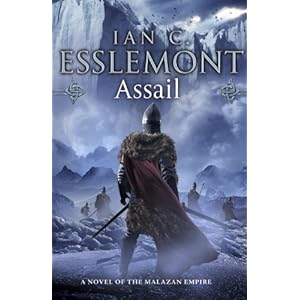
Book Review: Assail by Ian C Esslemont

Look at it! It's so awesome!


Hopefully I was not alone in my giddy excitement when I saw the title of this book.

Assail.

All Malazan fans will know the weight that sits on that continent. Throughout Erikson’s series we have seen some of the toughest characters be chewed up and spat out by Assail. And sometimes they even survive.

We enter the world of Malazan once again as we always do, with some new characters and some old faces, and I think by now with 15 books under most readers’ belts (I’m going to assume that you’ve read Esslemont’s series after you read Erikson’s) we have enough context that we are immediately drawn into the new stories. A young man from one of the tribes on Assail and a sea-captain on his way to the fabled continent are a couple.

Esslemont does a wonderful job of building tension and suspense in the first portion of the book. We are only given fleeting glimpses into what lies at the heart of the continent and what terrible things might happen. Further to this we are thrown a complete curve-ball with the prologue and only left with burning questions.

Esslemont builds on this consistently throughout the entire book and we are given hints, both great and small, about what is happening and important revelations about the world. I could barely put the book down in the first half for all of these hints and questions (I almost missed my stop a couple of times on the train) and then by the time the second half of the book comes around you’re caught up with the momentous plot you can’t put it down then either!

I will say that for some reason around Chapter Six there was this weird explosion of adverbs. As though Esslemont realised that adverbs can be okay sometimes and got a little carried away. It was a little off-putting once I realised he wasn’t doing it deliberately with one character to try and make a statement about their POV, but then after that chapter it dies down and all is well with the world.

Apart from the ‘Adverb Attack of Ch. 6’ Esslemont’s language is diverse and descriptive, and I did note at times how wonderfully creepy he could be (in all the right places). Esslemont’s voice really shines and I think that he has developed wonderfully since ‘The Night of Knives’ way back in 2004. He gives the proper weight and sadness to those characters and scenes that need it but is also a dab hand at cracking jokes. There was a wonderful moment in a climactic fight scene towards the end that did give me a mighty chuckle.

The Epilogue does a wonderful job of tying everything together in a neat little bow. I did wonder whether it was necessary and should have been a final chapter, but perhaps that’s just pedantic of me? Regardless, the Epilogue ties all of the threads of this book together and then shows us some of the paths the characters want to take next. So instead of leaving us with the unanswered questions that we were sometimes left with in Erikson’s work, Esslemont ties everything together and then scatters the seeds for the next round of storytelling. And each and every single one of those seeds should be an epic story in its own right.

By the time we reach the end of the book the world has been suitably threatened, our view on it has been suitably rocked, and we have had our hearts suitably broken. All in all, Esslemont continues to build and improve on his previous work. Every volume increases in complexity, skill, and epic scale.

I absolutely urge any fantasy fan to read the Malazan series, and if any Malazan fans are hesitant to pick up Esslemont’s series after what a good job Erikson did, I can assure you that you will not be disappointed. Esslemont has at least 3 more books to go and I for one cannot wait to read them. 


Assail is released on the 14th August and you can preorder it in hardback or ebook from Amazon, or from the publisher's website.
Continue Reading...

Thursday, 3 April 2014

And Now For Something Completely Different! A Real Tale From History

I love me some history, I love it so much that I studied various kinds of history for pretty much my whole education. I grabbed 2 degrees in Classics and Ancient History (they were mine I promise, I didn't steal them).

One of the things I love about it is all the stories that you could make from it. Maybe one day I'll give it a go! But for now, I shall just tell you about one of my favourite episodes from Ancient History! Maybe you could make it into a story, or at the very least I hope it interests you.

Now we all know that people can make hasty decisions when their blood is up. You're excited, angry or sad so maybe you're not making the best choices?

There is an episode from ancient Athens that sums this up pretty perfectly.

At the time (427BCE) Athens' power sprawled across the ancient world and across the oceans. There was a large hegemony of city states that bowed to the Athenian's power, called The Delian League. Athens had a large amount of territory, but even father was their territory they controlled via their tributaries. Of course a lot of people weren't happy about being forced to pay Athens a variety of tithes and there are several episodes of city-states trying to secede.


In 427BCE one of the states that tried to do so was called Mytilene. The city was on the other side of the Aegean to Athens, and were very unhappy with the Athenians. They even sent an envoy to Olympia to seek help against the Athenians with their revolt, saying that the Athenians had abused their power with the Delian League. Maybe that's true, or maybe the oligarchy that rules Mytilene wanted to unite the power of their island of Lesbos, something the Athenians would never allow.

So one thing led to another and they revolted. Sorted.

But, alas! Someone tipped off the Athenians (one of the other powers on Lesbos, and some internal dissenters) and war broke out. That's all well and good of course, except that Mytilene nor their allies were ready for it, and got their arses handed to them. That led to their negotiating terms which was essentially them surrendering.

The Athenians allowed the Mytilenians to send an envoy to Athens and plead for compassion. The envoy was summarily executed on his arrival at Athens and the Athenians began a debate to decide what to do with all the rebels.

Now, the Athenian Assembly consisted of every Athenian citizen (and here follows one of the dangers of a direct democracy) and so they could all vote on what to do next. The Athenians were scared of further revolt and enraged by this thought out plan to thwart their power. After all more than one of the city states on Lesbos has risen against them and had orchestrated an attack on Attica to help them out (them being the Mytilenians that is, it didn't help the Athenians).

So the Athenians decide that the best defence against further revolt is a good offense. Of course that means slaughtering all the men and selling the women and children into slavery. Huzzah!

And there goes the Trireme to carry it all out. Not a bad day's work, eh fellow Athenians? Phew, time to hit the sack!

The next day, they realised that maybe they'd been a bit harsh. I mean, did they really need to kill everyone? Maybe not. Another debate ensued. Whereas before every single Athenian had been in favour of utter annihilation, now even the most bloodthirsty from the day before were hesitant. This led to a narrow margin in favour of not killing everything.

Another trireme was sent out, with double the normal crew, to catch up with the first. Luckily for the Mytilenians both triremes arrived at about the same time and in what I'm sure was a crazily intense scene, the old orders were overruled.

So instead of death and destruction for anyone and everyone, they merely razed the walls, replaced the oligarchy and divied up the land of Lesbos.

Yay, democracy!
This episode I think clearly outlines the dangers of being too loose and easy with your pent up emotions. And just imagine what would have happened if the second ship hadn't reached them in time! Could it have led to a revolt that spanned the Aegean? Does it send the Athenian people into a spiraling miasma of depression and despair?

I hope you enjoyed this little segment, maybe it'll spark some ideas, maybe you just found it interesting. I hope both, and more!

More to be coming soon!
Continue Reading...

Tuesday, 21 January 2014

Steelheart Review

I thoroughly enjoy superhero stories, going right back to watching Spiderman cartoons every Saturday when I was a kid.


And given my absolute enjoyment that I got out of the Mistborn books I thought that the Steelheart books would be a no brainer enjoyment roller coaster. In some ways, it was.


The story tells of a world after Calamity, a big burst in the sky that’s given some people superpowers. And these people became Epics, but far from saving the world from its ills and evils, the Epics essentially became the superhuman overlords of the mortal populace. If you’re not an Epic, then you’re not worth anything, you just keep your head down and try to do the best you can without pissing off someone with any powers whatsoever so they don’t kill you.


Some of the Epics are strong and capable of ruling both Epics and normal people alike with an iron fist. It is one of these Epics that is the main antagonist, Steelheart who has taken Chicago and all the people in it and become their Emperor. Steelheart is essentially a superman like character with invulnerability, flight, super strength, energy blasting out of his hands, and most interestingly can change inanimate objects to steel.


Our protagonist, David, is the only person alive who has seen Steelheart bleed, everyone else believes him to be invincible. Steelheart went on a rampage when he did get injured, killed all the witnesses, the rescue workers and buried the bank it happened in. So he feels it’s vital that he meets and goes with the Reckoners, the only group of normal people who stand up to Epics.


But that’s enough of the story, I don’t really want to give too much away.


The writing of the book was never bad and I thought that some of the aspects of the world were quite interesting, like the Epics weaknesses. It provided an excellent sense of danger to fighting the Epics, even if they knew what the weakness was they still have to try and make sure the situation was just right to pull it off.


Technologically Sanderson made good use of the Epics to kick start some very sci-fi devices and so keep the world fresh enough that you never know quite what’s going to happen next.


The main character, David, was never irritating, always tried to do the right thing and I think that Sanderson did a good job of making his love story seem a bit immature like the character was. Pushed into the dangerous and very mature world of fighting Epics, we still find David emotionally immature in other areas, despite his encyclopedic knowledge of Epics.
But for all that it lacked a certain something. It almost felt like Sanderson was publishing this book just so he could write something about superheroes. The underlying theme of the book, whether power corrupts and the lengths you should go to stop dictators, didn’t seem to be organically worked into the story. It seemed to me that all of a sudden this theme was shoved right in your face. Something that reinforced this for me was the whole ‘geek’ thing with David. Sanderson seemed intent on making sure that you knew David was being identified as a geek. This could just be me being cynical but it struck me as something cheap to try and get David to connect with the readers at this point.


Overall, I was a bit disappointed with Steelheart really. I was hoping for something just as enjoyable and occasionally mind-bending as the Mistborn series. But what I got was the written equivalent of an okay action movie. It wasn't a bad experience and it wasn't badly done, it was enjoyable, but it wasn’t anything that would leave you speechless.

So if you’re looking for a bit of a romp through a post-apocalyptic world with superheroes rampaging about then this book will suit you. Don’t set yourself up for the most amazing read you’ll ever see, but you will find an enjoyable story with action and adventure to keep you entertained.
Continue Reading...

Wednesday, 26 June 2013

When I Finished Malazan (Or the Day I Cried on the Train)


Okay, I’m going to start this week’s article off with a couple of points just for some context. First off,  I get most of my reading done on the train to and from work, because it’s nice to just have an hour either way that I can just spend reading without worrying about chores, blogging or anything else.

And secondly, I’m a pretty big fan of epic fantasy. I love a sprawling adventure with Homeric style gods and heroes and a storyline to rival mythology. It’s even why I did two degrees in Classics and Ancient History. So it’s understandable that when I started reading Malazan: Book of the Fallen by Steven Erikson I quickly fell in love with it.

Spanning an 10 books with an average of 1,146 pages and 330,003 words per book, the story covers multiple continents and hundreds of thousands of years. Well the books don’t cover hundreds of thousands of years, but they do tell you about the history and ... well I won’t go on too much about that, but it’s safe to say that it’s pretty darn epic.

And last week, I finally finished it.

So I thought it was about time that I reviewed Malazan, and instead of just reviewing one of the books I am going to review (to the best of my abilities) the series as a whole. I will be looking at the writing, the story, the pacing and the characters but just taking into account the whole series instead of the individual instalments. And having already said how much of a fan I am of epic fantasy I think it is important to try and do this review as evenly as possible so I won’t just be talking about the positives. I’m going to try as hard as I can not to give any spoilers and I will read and reread this article to make sure!


So let’s get the negatives out of the way early!

The Malazan series definitely starts as an uphill struggle, one of my good friends has described it as ‘Fantasy for fantasy fans’  and I agree. Erikson is not a fan of holding the readers by the hands as they come to terms with the strange new world they find themselves in. You’re immediately thrown into a world with a rich history and diverse political backdrop with minimal guides to help you understand all of it. With this particular aspect of his storytelling it seems like Erikson really takes to heart the mantra of ‘show don’t tell’. Even with that being said, the story of the first book Gardens of the Moon, is relatively small within the scale of the Malazan series so Erikson at least lets you in at the shallow end. But he doesn’t tell you how to swim.

A point that runs alongside that is the tendency for storylines and prose that don’t seem relevant from the reader’s perspective. I can think of about three or four examples of this, although within the later books (I won’t specify them in case I give anything away). But one example I will give specifically is that in one of the later books he has sections of text written as though they are narrated by one of the characters, Kruppe to be exact. However, the problem I found with this is that Kruppe is never exact. He is a highly amusing character and has some wonderful speeches throughout the series, but with his complexity comes a need to use him sparingly. And so I did find myself mentally exhausted at some parts when Kruppe was giving his narrative. But I have also had conversations with people who fell in love with Kruppe and couldn’t get enough of him so this may be a case of personal opinion.

Additionally I found myself irked by the way Erikson started quite a few sections that moved to a different point of view. There would be a couple of paragraphs of description and setting before he named the character or gave enough description that the reader could then realise what character this particular section was narrating. Although, in fairness, this mostly annoyed me due to my own impatience and wanting to read about certain characters. 


But I don’t want the negatives to throw you away from the series, it takes a bit of time to get into but once you get there the payoff is immense. So let’s look at what I did like about the series.

Well, I’ve said I like epic fantasy, and it is truly epic. Without counting the magical realms that are used throughout the series, the story spans at least three continents. And in true fantasy style humans are only one of many different races and not all of them humanoid. There’s the undead cavemen that are the T’Lan Imass; the ancient reptilian race of the K’Chain Che’malle; and the giant secluded Toblakai. Steven Erikson follows characters from every single race so we really get the full scope of the world as we go through the series. That in itself shouldn’t necessarily be a reason to pick up a book, you could have a novel that’s very epic but poorly written and plotted. Erikson doesn’t write poorly, his plot is well planned and the pacing keeps you reading.

Moving on from the setting, the characters themselves are compelling and interesting, there is never a character placed just to fill a space. And each and every one of them has their own backstory, drives and motivations. Along the same lines Erikson doesn’t push the plot along merely to get his characters in a certain place or, indeed, push the characters to do something contrary just to get the plot to a certain place. In this way I found that the story was always intriguing and unpredictable, not just because Erikson wants to keep you guessing meaninglessly but because you can’t say what life will throw at the characters next.


I will admit that I have a slight bias, as I don’t mind making my way through books that are positively tomes that could be used as weapons. But whilst he definitely keeps you entertained throughout the book Erikson makes the journey to the end of each book absolutely worthwhile. The man can do endings. You know that feeling where you have to put down the book and just think ‘Flip. That was awesome/ridiculous/has so many implications.’ That’s pretty happens a couple of times at the end of every book. The number of times that the hairs lifted on my neck as I reached a climactic and impressive part of the story became too many to count.

This does feed in a little bit with the con that it takes a long time to get all the context in order for this series. Once you’ve got the context of the setting and the history that’s been created for the world of Malazan the payoff is huge. I wouldn’t blame anyone for not pushing through to get to those endings but I would also definitely say you should not give up on it. 

I have seen Erikson called a master of both tragedy and comedy and you will definitely see that throughout this series. Characters like Kruppe, Tehol and the Korbal and Bauchelain duo will have you laughing as you read. But as you reach some climaxes in the series (I won’t say which ones) you will find yourself shedding a tear or two for the characters and their pitfalls. And this was my mistake. As I read the climax to the series I found myself on the edge of my seat leaning into the book hoping to dive even deeper, there was a lot of wide-eyed stares at the pages and a couple of teary eyed glances out the window.

The story is presented to you with excellent writing, interesting plots (most of the books are self-contained but have an overarching story throughout the series that culminates in the later books) and three dimensional characters.

The series does take some time to get into, for example it takes him until the sixth book to actually give a definition of the magic system, despite the fact that by then you’ve figured it out by yourself. But that’s mainly because the world is so rich it would just be ridiculous to try and give you all of the information at once. The reason that the endings are so effective, spectacular and simply epic is because of all that context and the rich world. 

I have laughed with this series and I have cried with this series, Erikson took my on a truly epic journey and left me speechless. Reading this series has definitely affected me and I think changed my outlook. For all of its faults this series is phenomenal, I cannot recommend it enough. I genuinely felt lost for a good few days when I had finished the series, bereft at the sudden lack of those same characters in my life.

If the Malazan: Book of the Fallen is a series you’ve been umming and erring about I strongly recommend you pick it up. Yes, it’s long. Yes, it’s daunting. And yes, it’s well worth it. 
 
Continue Reading...

Followers

Follow The Author